
Why 3/4" Plywood Matters: The Hidden Truth About Cabinet Longevity (Especially in a Mid‑Century Modern Kitchen)
- Heather Gordon

- Dec 10, 2025
- 6 min read
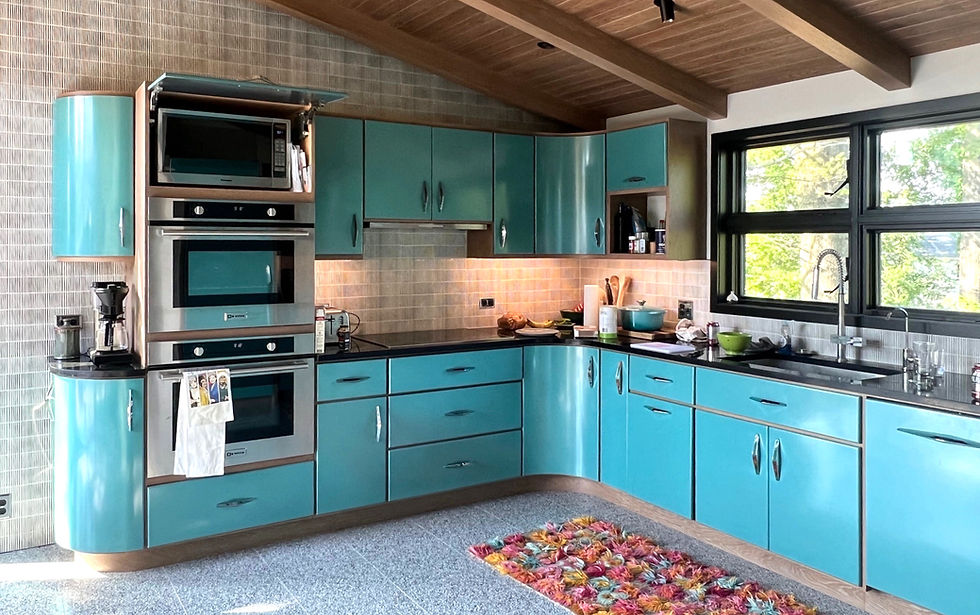
If you’ve ever gone down the rabbit hole of custom cabinetry, you’ve probably seen terms like “3/4" plywood,” “MDF,” and “particle board” thrown around. It can sound like insider jargon—until a drawer starts sagging, a sink base swells, or a cabinet box pulls out of the wall years earlier than it should.
For a mid century modern kitchen—where clean lines, flat fronts, and seamless metal or wood panels are the whole point—the structure underneath matters even more. At Toro Kitchen Cabinets, we build custom metal and mid century modern cabinets designed to look amazing and last decades, not just through the next trend cycle.
This post breaks down:
Why 3/4" plywood is a big deal for cabinet longevity
How it compares to particle board and MDF in real life
Why joinery (dado, rabbet, etc.) matters more than most people realize
A simple “cost-per-year” way to think about your cabinet budget
The Backbone of Your Kitchen: What Are Cabinets Actually Made Of?
Most homeowners focus on color, door style, and hardware.
Designers and fabricators obsess over something much less sexy: the box.
When we talk about custom kitchen cabinets—especially mid century modern metal or wood cabinets—we’re really talking about:
The cabinet box (sides, top, bottom, back)
The doors and drawer fronts
The hardware (hinges, slides)
The finish (paint, veneer, powder coat, etc.)
The box is where material quality makes or breaks cabinet longevity.
Common Cabinet Box Materials:
1. Particle Board
Made from wood chips and sawdust pressed together with resin
Usually 5/8" or 1/2" thick in budget lines
Very cost‑effective for manufacturers
Hates moisture; can swell, crumble, or blow out around screws over time
You’ll often find this in:
Big box “budget” cabinets
Some flat‑pack / RTA (ready‑to‑assemble) lines
2. MDF (Medium-Density Fiberboard)
Wood fibers + resin, denser and smoother than particle board
Great for painted door panels (smooth finish, no wood grain)
Still not very happy in high‑moisture areas unless well sealed
Heavy, and screw holding is so‑so compared to real plywood
You’ll see MDF commonly used for:
Painted shaker or slab doors
Some mid‑range cabinet boxes
3. 3/4" Plywood
Thin layers (plies) of wood veneer glued with the grain alternating direction
Much stronger and more dimensionally stable than particle board
Excellent screw‑holding and resistance to warping
Handles normal kitchen moisture and weight far better
This is the go‑to for higher‑quality custom kitchen cabinets, including many mid century modern cabinet lines where longevity matters.
At Toro, when we’re not building full stainless steel cabinet boxes, we use 3/4" plywood boxes paired with powder‑coated metal doors and panels to get that clean, modern, mid century look with real structural strength behind it.
Why 3/4" Plywood Matters So Much
Think of your cabinet box as the frame of a house. You rarely see it, but everything depends on it.
Here’s what 3/4" plywood does better than particle board or MDF:
1. Strength & Weight Support
Holds heavy quartz or stone countertops without sagging
Supports loaded drawers, pull‑outs, and pantry units over time
Keeps wall cabinets square and secure, even when packed with dishes
In a modern or mid century modern kitchen, where you might have:
Long runs of flat‑front cabinets
Integrated appliances
Tall pantry sections
…you’re asking a lot from those cabinet boxes. 3/4" plywood handles that load in a way lighter, weaker materials just don’t.
2. Moisture Resistance (Real‑World, Not Just Lab Talk)
Kitchens are humid. Sinks leak. Dishwashers steam. Coffee machines and kettles live under uppers.
Particle board can swell, split, and crumble when exposed to repeated moisture.
MDF does a bit better but still doesn’t love long‑term humidity or leaks.
Plywood is layered, with better glue and alternating grain—it can still be damaged, but it’s much more forgiving.
If you’ve ever seen a cabinet floor under a sink bubble up and disintegrate, you’ve seen the downside of cheaper materials.
3. Screw Holding & Joinery Strength
Cabinets are held together—and held to your walls—by screws and joinery.
In particle board, screws can strip out over time, especially with weight and movement.
In plywood, screws bite into real wood layers and stay put significantly longer.
This matters for:
Hinges (doors that don’t sag or fall out)
Drawer slides (smooth, aligned drawers for years)
Wall cabinet hanging rails (nobody wants those coming down)
Joinery: Dado, Rabbet, and Why It’s Not Just Glue & Staples
Material is one side of the longevity equation. The way your cabinets are assembled is the other.
Cheap & Fast: Staples + Butt Joints + Glue
Many mass‑produced cabinets use:
Flat pieces of board
Glued and stapled together at the edges (butt joints)
Sometimes with little or no mechanical joinery
This is fast and cheap—and it works for a while. But over time, with weight, movement, and humidity, those joints can loosen and fail.
Strong & Intentional: Dado and Rabbet Joinery
In higher‑quality and custom cabinetry, you’ll hear terms like:
Dado joint: A slot is cut into one board, and another board fits into that slot.
Rabbet joint: A step is cut along the edge of a board; another board nests into that step.
Why this matters:
The joint is mechanical, not just relying on glue and staples.
Surfaces interlock, spreading out stress instead of concentrating it on a tiny glue line or a few staples.
When combined with 3/4" plywood, glue, and screws, you get a cabinet box that behaves more like a piece of furniture than disposable storage.
At Toro, our focus on custom mid century modern cabinets means we care a lot about these invisible details. Clean, flat fronts and metal doors only look right when the box behind them stays square and solid over years of daily use.
Mid Century Modern + Metal: Where Structure Really Shows
Mid century modern cabinetry is unforgiving. There’s nowhere to hide.
Flat fronts show every misalignment.
Continuous runs highlight even small sags or racking.
Sleek stainless steel and powder‑coated metal doors look best when the underlying structure doesn’t twist or settle.
That’s why for our custom metal cabinets, we either:
Use full stainless steel construction for maximum durability, or
Pair 3/4" plywood boxes with metal, powder‑coated doors and panels for a warm‑meets‑industrial mid century modern feel.
Either way, the construction is designed to last decades, not just a few trend cycles.
Is 3/4" Plywood Really “Worth It”? A Simple Cost‑Per‑Year Look
Let’s talk about the budget side, because this is where a lot of homeowners feel sticker shock with custom cabinets.
Imagine two scenarios for a mid‑sized kitchen:
Option A: Cheaper Boxes (Particle Board / Thin Materials)
Cabinet package cost: ~$12,000
Realistic lifespan before noticeable issues / replacement: ~10 years (sometimes less, sometimes more, but 8-10 is common)
Cost per year: $12,000 ÷ 10 years = $1,200 per year
Option B: Quality Boxes (3/4" Plywood + Better Joinery)
Cabinet package cost: ~$18,000 (higher upfront)
Realistic lifespan: 20+ years when well‑built and cared for
Cost per year:$18,000 ÷ 20 years = $900 per year
In this simplified example, the “expensive” cabinets are actually cheaper per year—and that doesn’t even factor in:
Less frustration (doors that stay aligned, drawers that keep gliding smoothly)
Better resale value (buyers notice solid cabinetry)
The ability to update doors/finishes later without rebuilding the entire kitchen
For a lot of our clients at Toro, the math—and the long‑term peace of mind—makes 3/4" plywood and high‑quality construction a clear choice, especially in a forever home or a long‑term mid century modern renovation.
How to Use This When You’re Comparing Cabinet Quotes
When you’re collecting quotes for custom or semi‑custom kitchen cabinets (metal or wood), don’t just look at the bottom line.
Ask:
What are the cabinet boxes made of?
3/4" plywood? 5/8" particle board? MDF? A mix?
How are the boxes joined?
Dado / rabbet + glue + screws? Or just glue and staples at the edges?
What thickness are the sides, bottoms, and backs?
3/4" throughout, or thinner in “hidden” areas?
How long are these cabinets realistically expected to last?
Ask the question directly. See if the answer sounds confident and specific.
If you’re looking for a true mid century modern kitchen—clean lines, metal details, durable finishes—these questions are just as important as color and style.
How Toro Approaches Construction Quality
At Toro Kitchen Cabinets, our whole niche is custom mid century modern metal cabinetry for residential kitchens. That means:
3/4" high‑quality cabinet boxes (or stainless steel construction)
Thoughtful joinery and hardware designed to handle real‑world daily use
Powder‑coated metal doors and panels for a durable, beautiful finish
Layouts that are functional first, then obsessively refined for that modern, minimalist look
If you’re curious how this would translate to your kitchen, we’re happy to walk through:
What materials make sense for your budget and how you cook
Where to splurge (like drawers and long‑term structure) and where to save
How to get that mid century modern look with cabinets that will actually go the distance
You don’t have to become an expert in plywood, dado joints, or powder coat. That’s our job. But knowing the basics—and asking the right questions—can be the difference between cabinets that just look good in photos and cabinets that still work beautifully 20–40+ years from now.


Comments